Atal Bandhkam Kamgar Awas Yojana — Check List, Status
No match. Check the spelling.
No match. Check the spelling.
No match. Check the spelling.
No match. Check the spelling.
What is Atal Bandhkam Kamgar Awas Yojana?
Atal Bandhkam Kamgar Awas Yojana is run by the Maharashtra Building and Other Construction Workers Welfare Board (MahaBOCW), which works under the state’s Industry, Energy and Labour Department. Because it is a welfare board scheme, it covers only construction workers whose names are on the board’s register.
The scheme has two parts. The rural part was approved by a Government Resolution of 14 January 2019, and the urban part runs alongside PM Awas Yojana in towns and cities:
Most of this page is about the rural part, since that is where the board pays for the house directly. The urban part is covered in its own section further down.
The rural scheme is still in force. Zilla Parishad Kolhapur lists it as a current state-funded scheme for the period from 18 July 2025 to 16 July 2029.
Workers who are not on the board’s register can look at the state’s community-based gharkul schemes instead: Modi Awas Gharkul Yojana for OBC, VJNT and SBC families, Ramai Awas Yojana for Scheduled Caste and Neo-Buddhist families, and Shabari Awas Yojana for Scheduled Tribe families.
Free on Awas Score
How to check the Atal Bandhkam Kamgar Awas Yojana list on Awas Score
The quickest way is the free tool at the top of this page. Our lookup engine finds the Atal Bandhkam Kamgar houses in your gram panchayat and shows them here, so you don’t have to search for them. No sign-up, no fee.
- Choose Beneficiary list. It is already selected when the page opens.
- Choose your area. Select your District, Block and Gram panchayat in Maharashtra. You can type in each box to find your place quickly.
- Pick the year, if you know it. Leave Financial year on Every year to see every house, or pick the year the house was sanctioned.
- Open the list. Click Show the list. You’ll see every Atal Bandhkam Kamgar house in your panchayat, with its beneficiary ID, the beneficiary’s name, father’s or husband’s name, house status and the amount released so far.
- Check your house. Type your name in the search box, then click your beneficiary ID. Beneficiary details opens with the ID filled in, and shows the instalments paid and how far the house has got.
Tip: already have your beneficiary ID? Choose Beneficiary details and type it in. If a question appears, answer it. Most of the time your record opens straight away. The list has the rural scheme’s houses only, and many villages have none yet: if yours shows no house, that is usual. A house with Not sanctioned yet as its status is registered, but not yet approved.
How to check the Atal Bandhkam Kamgar Awas Yojana list on the official website
Atal Bandhkam Kamgar houses are recorded in AwaasSoft, the same system as PM Awas Yojana Gramin. You can also open your panchayat’s list yourself on its Advance Search page:
- Open the search page. Go to the AwaasSoft Advance Search. It isn’t in the website’s menu, so use this link.
- Choose your area. Select MAHARASHTRA as the State, then your District, Block and Panchayat.
- Choose the scheme. In Scheme name, select Atal Bandhkam Kamgar Awaas Yojana Gramin. Pick a Financial year too, or leave it on Select to see every year.
- Open the list. Click Search. The houses show 25 to a page, with the page numbers below the list.
How to check your Atal Bandhkam Kamgar house status on the official website
Every house in the list has a beneficiary ID, such as MH-12-345-678-001/A14. With it you can open the house’s full record:
- Open the website. Go to pmayg.dord.gov.in.
- Choose Stakeholders. In the menu, go to Stakeholders and choose IAY/PMAYG Beneficiary.
- Enter the ID. Type the beneficiary ID in Registration Number / Beneficiary ID, answer the question below it and click Submit.
The record shows the sanction, every instalment paid with its FTO number, and each stage of the house’s construction. A house that is registered but not yet sanctioned shows the family and the place, with no instalments yet. Don’t have the ID? Find your name in the list first: the ID is written next to it.
Financial assistance under the rural scheme
The board pays for the house first. The land money comes later, once the house is complete:
The ₹1.50 lakh already counts two amounts that rural housing schemes usually add separately: ₹18,000 that would come as MGNREGA wages for work on the house, and ₹12,000 for a toilet under Swachh Bharat. Because they are part of the ₹1.50 lakh, a worker can’t claim them again from those schemes for the same house.
The ₹50,000 was added by a second Government Resolution, dated 7 February 2019. It is a reimbursement, so the worker spends the money first and claims it back with the completion certificate.
The house must have a carpet area of at least 269 sq ft, with a kitchen and a toilet.
Eligibility for the rural scheme
A worker has to meet every condition in the first list, and none in the second:
You can apply if
- You are registered with the welfare board, and the registration is active on the day you apply
- You have been registered without a break for more than one year
- You live in a rural area of Maharashtra
- You have land or a kutcha house to build on, shown in a 7/12 extract, a property registration certificate or the Gram Panchayat’s property record
You can’t apply if
- You or your husband or wife already own a pucca house anywhere in Maharashtra
- Someone in your family has already received this help, since it is given once per family
- You have taken this benefit before, as a worker can get it only once
Registration with the Welfare Board
Only a registered worker can apply, and a fresh registration has to be more than a year old before the worker can apply for the rural housing help. These are the board’s conditions for registering:
- Age between 18 and 60 years.
- More than 90 days of construction work in the last 12 months. This is shown with a 90-day work certificate.
- Proof of address and an Aadhaar card. Both are asked for before the registration form opens.
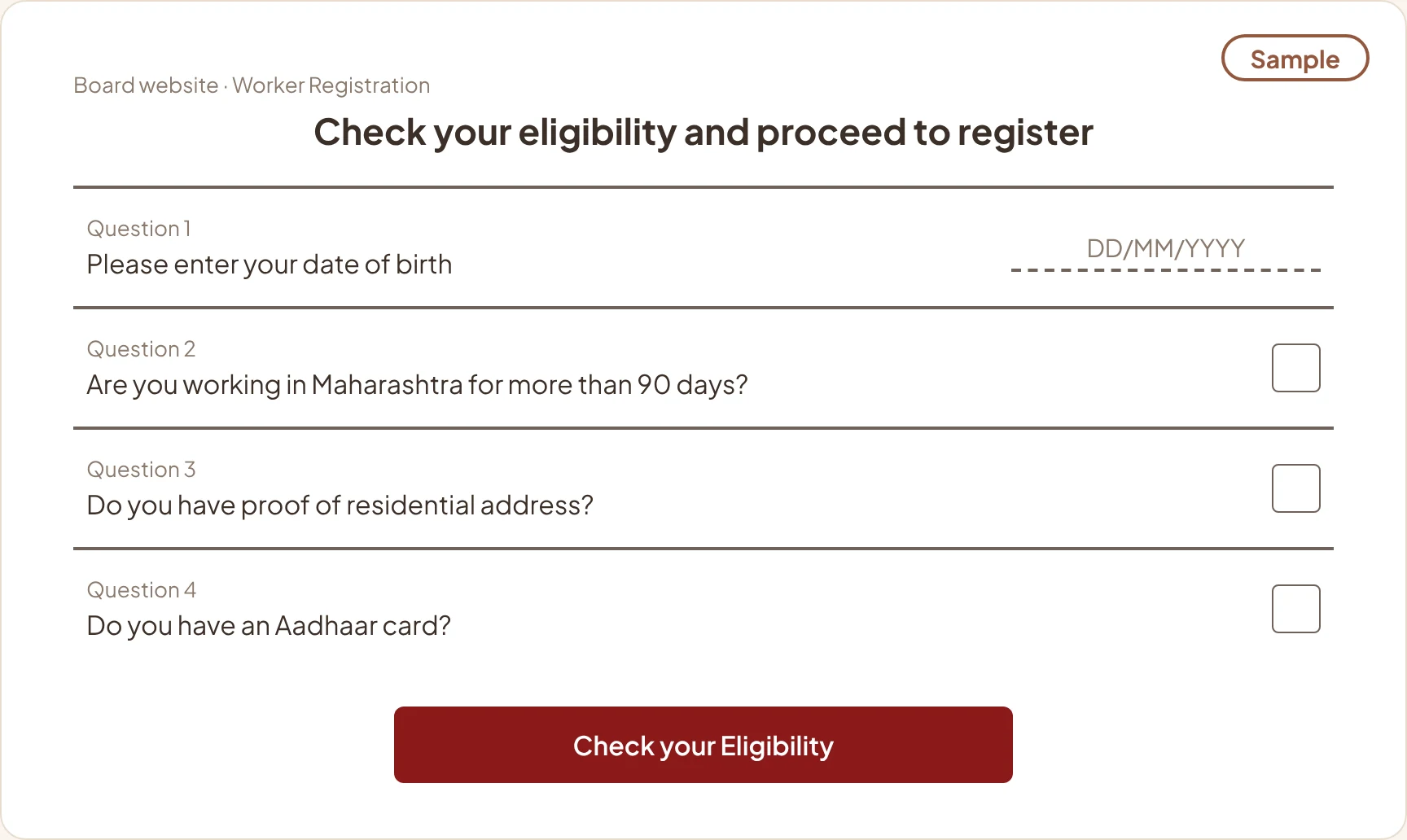
The board’s worker registration page starts with a short eligibility check. It asks for the date of birth and whether the worker has worked in Maharashtra for more than 90 days, has proof of address and has an Aadhaar card. If the worker meets these conditions, the next step is the online registration form.
The registration form is Form-V, and it is submitted with these documents:
- Proof of age
- The 90-day work certificate
- Proof of residence
- Proof of identity
- Three passport-size photographs
The 90-day certificate has to be in the board’s current format, which is on its download page. There are separate versions for a certificate issued by the Gram Sevak and one issued by a developer. The registration page also lists which kinds of construction work are recognised by the board.
The registration page puts the fee at ₹1, with a subscription of ₹1 a year. The board gives appointments for registration, renewal and benefit claims, and its website says the appointment dates for all three have been extended to 31 December 2026.
Renewal of registration
A registration is valid for one year, so it has to be renewed every year. Each renewal needs a fresh 90-day work certificate covering the previous year.
Renewing on time matters for this scheme in particular. The rural housing help needs more than one year of unbroken registration, and only a worker whose registration is active on the day of applying can claim it.
- Open the renewal page. Go to the renewal form on the board’s portal. In the Select Action box, choose New Renewal and click Proceed to Form.
- Enter your registration details. Fill in the registration number, the worker’s name, the mobile number and the date of birth.
- Add the 90-day certificate details. The form asks for the details of the work certificate, starting with the nature of the worker’s work.
- Submit the form. Like registration, renewal is then handled through an appointment with the board.
How to apply offline
The rural application is made on paper, on the board’s prescribed form. From registration to the last payment, it moves through these stages:
- Start hereRegistrationActive, and more than a year old
- ApplicationForm submitted at the board’s district office
- SelectionDistrict-level committee approves the name
- ConstructionAt least 269 sq ft, with kitchen and toilet
- Land claimUp to ₹50,000 after completion
- Get the form. The form for the rural scheme is listed on the board’s welfare schemes page. It is also available at the board’s district office.
- Fill it in and attach copies. Write your registration number and details exactly as they appear on your board card, and attach copies of the documents listed below.
- Submit it at the board’s district office. The form goes to the District Executive Officer or the Deputy District Executive Officer of the welfare board for your district. Some districts, such as Palghar, also route it through the Block Development Officer at the Panchayat Samiti. Ask for a receipt when you hand it in.
- Wait for selection. A district-level committee goes through the applications and approves the beneficiaries.
- Claim the land amount after completion. Once the house is finished, apply again with the completion certificate to get back up to ₹50,000 spent on land and related costs.
The rural scheme is implemented through the State Management Cell for Rural Housing, the office that also runs Maharashtra’s other state-funded housing schemes in villages.
Documents required
The district scheme pages ask for these papers with the rural application:
- Board identity card as a registered worker
- Aadhaar card
- 7/12 extract, property registration certificate or Gram Panchayat property record
- Passbook of a savings account in your own name
The land paper shows where the house will be built. The savings account has to be in the worker’s own name, because the board pays the money into it.
Keep the completion certificate safe after the house is built. It is needed for the ₹50,000 claim, which is made separately.
Housing assistance for workers in towns and cities
For workers in towns and cities, the board’s housing help is tied to PM Awas Yojana. It was set up by a Government Resolution of 3 February 2018, and the board lists it as the urban part of Atal Bandhkam Kamgar Awas Yojana.
The board’s application form for financial schemes lists two housing benefits for registered workers:
- Scheme F03: the interest on a bank home loan of up to ₹6 lakh, taken to buy or build a house, or a grant of ₹2 lakh.
- Scheme F04: a ₹2 lakh grant through the board for workers who are eligible under PM Awas Yojana Urban. The worker needs a letter from the competent officer, or a certified list, showing that eligibility.
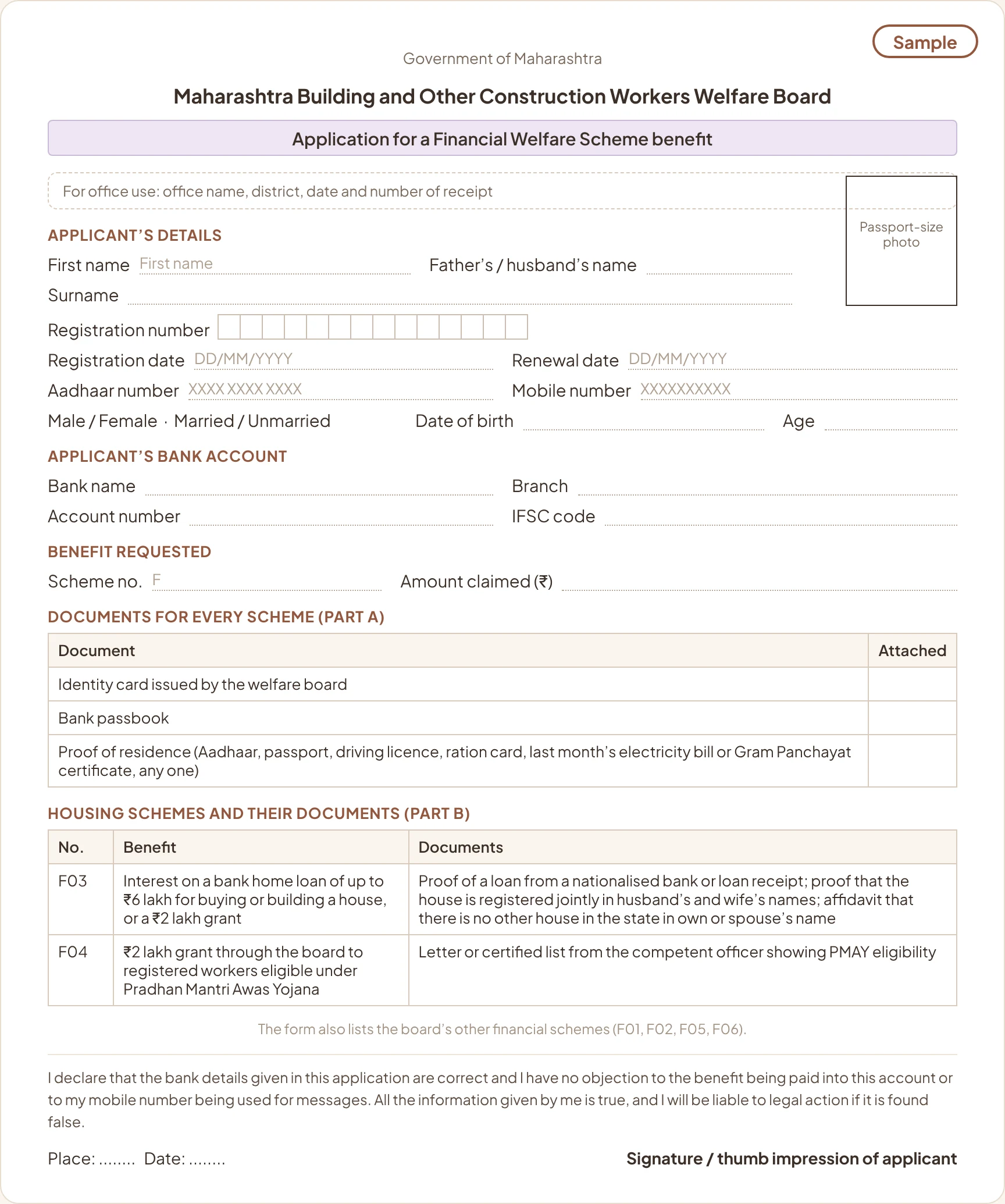
Every claim on this form needs the board identity card, the bank passbook and one proof of residence. An F03 claim also needs proof of a loan from a nationalised bank, proof that the house is registered jointly in the husband’s and wife’s names, and an affidavit that the worker has no other house in the state in their own or their spouse’s name.
A city worker claiming under F04 therefore has to apply under PM Awas Yojana Urban first. Once the worker is found eligible there, the board’s help is claimed with the PMAY eligibility letter attached to this form.
Helpline and contact details
For questions about registration, renewal or a pending claim, the board can be reached here:
- Toll-free helpline
- 1800-8892-816, from 10 am to 6 pm
- support@mahabocw.in
- Head office phone
- 022-2657-2631 and 022-2657-2632
- Head office
- 5th Floor, MMTC House, Plot C-22, E-Block, Bandra Kurla Complex, Mumbai 400051
The board’s website also lists phone numbers for each district office. For an application already submitted, the district office that received the form is the first place to ask.
Common questions about Atal Bandhkam Kamgar Awas Yojana
Who can get help under Atal Bandhkam Kamgar Awas Yojana?
Construction workers registered with the Maharashtra Building and Other Construction Workers Welfare Board. For the rural part, the registration must be active and more than a year old, and neither the worker nor the spouse can own a pucca house in Maharashtra.
Is the rural grant ₹1.50 lakh or ₹2 lakh?
The house grant is ₹1.50 lakh. Once the house is complete, the board pays back up to ₹50,000 more for land and related costs, so the most a worker can get is ₹2 lakh.
Where do I submit the rural application?
At the welfare board’s district office, to the District Executive Officer or the Deputy District Executive Officer. Take a receipt when you hand in the form.
I live in a city. Can I apply?
Yes, through the urban part. You first need to be found eligible under PM Awas Yojana Urban, and then claim the board’s help with the competent officer’s letter showing that eligibility.
Can a newly registered worker apply?
Not for the rural scheme. The worker must have been registered with the board without a break for more than one year before applying.
How can I check the Atal Bandhkam Kamgar Awas Yojana list?
Use the free list tool at the top of this page. Choose your district, block and gram panchayat to see every Atal Bandhkam Kamgar house there. The same list is on the AwaasSoft Advance Search of the official PM Awas Yojana Gramin website.
How do I check my Atal Bandhkam Kamgar house status?
Click your beneficiary ID in the list, or choose Beneficiary details and type the ID in. You'll see the instalments paid and how far the house has got.
Awas Score
Building your own house? Check which other schemes can help your family.
Find out your family’s Awas Score in 2 minutes.
Get my Awas Score