Dr. Ambedkar Awas Yojana
In shortOfficial website
- A Gujarat government scheme for Scheduled Caste families who need a pucca house, in villages and in towns.
- The grant is ₹1.70 lakh, paid in four instalments as the house goes up.
- The family’s yearly income must not be more than ₹6 lakh, and the applicant must be at least 21.
- You apply on the state’s e-Samaj Kalyan portal and have two years to finish the house.
About Dr. Ambedkar Awas Yojana in Gujarat
The scheme was started in 1999 and is run by the Director of Scheduled Caste Welfare, under Gujarat’s Social Justice and Empowerment Department. The department says it is meant to give houses, a batch at a time, to poor Scheduled Caste families, and first of all to homeless families living below the poverty line.
A family that qualifies gets ₹1,70,000 to build a house. The amount is the same in a village and in a city, but the office in charge differs. In towns and cities it is the District Deputy Director, Scheduled Caste Welfare. In villages it is the District Social Welfare Officer.
The rules, the amount and the document list are all on the scheme’s page on the e-Samaj Kalyan portal, which is where the application is made too.
Which homes the grant can be used for
Applicants do not have to be homeless. The department’s page names three situations:
The first-floor route is for an adult son or brother of the person whose name the ground-floor house is in. He gets the grant for his own house upstairs, as long as the owner of the house gives consent.
How the ₹1.70 lakh is paid out
The money is paid in four instalments, each linked to a stage of construction:
- ₹30,000 to startPaid with the administrative approval order.
- ₹80,000 at plinth levelThe largest share, paid once the plinth is done.
- ₹50,000 when the roof is castPaid after the roof cast level is complete.
- ₹10,000 at the endReleased when the whole house, toilet included, is finished.
The house counts as finished only once it has a toilet. If you’re eligible for the ₹12,000 toilet grant, you get it separately under that scheme’s own rules. If you aren’t, the toilet has to be built out of the ₹1.70 lakh itself.
The grant may not cover the full cost of the house. Any further cost has to be met by the family.
Eligibility conditions
Besides belonging to a Scheduled Caste, every applicant has to meet these conditions:
| Rule | What the department says |
|---|---|
| Domicile | You must be a native of Gujarat |
| Income | Yearly income of up to ₹6,00,000, whether you live in a village or a town |
| Age | At least 21 years old |
| No earlier help | Neither you nor anyone else in your family has had a house under any government housing scheme |
| Cost of the house | At most ₹7,00,000 in a village and ₹10,00,000 in a town |
| Time to build | The house must be finished within 2 years of the first instalment |
| Plaque | A plaque reading “Rajya Sarkar ni Ambedkar Awas Yojana” goes up on the finished house |
There is one exception to the cost limit. If the help in a town comes under the Affordable Housing Scheme, the ₹10 lakh cap doesn’t apply. That scheme’s own limit is used instead.
Families who already have a PM Awas Yojana house
Such families cannot apply. The first rule on the department’s page says that neither the applicant nor anyone in the family should have had help under any housing scheme run by the government. A house under PM Awas Yojana Gramin or PM Awas Yojana Urban counts, and so does a house from any other state scheme.
You also confirm it in writing. The affidavit in the document list states that you haven’t had a house under this scheme or under another department’s housing scheme.
Other housing schemes in Gujarat
Gujarat runs several housing schemes, and each one is meant for a different group of families. Dr. Ambedkar Awas Yojana and Pandit Dindayal Upadhyay Awas Yojana are the easiest to mix up, since both give ₹1.70 lakh and both are applied for on e-Samaj Kalyan. The difference is the caste certificate the family holds:
| Scheme | Meant for | Help | Where to apply |
|---|---|---|---|
| Dr. Ambedkar Awas Yojana | Scheduled Caste families, income up to ₹6 lakh a year | ₹1.70 lakh in four instalments | Online on e-Samaj Kalyan |
| Pandit Dindayal Upadhyay Awas Yojana | SEBC, EBC and NT-DNT families, income up to ₹6 lakh a year | ₹1.70 lakh | Online on e-Samaj Kalyan, or on paper at the district office |
| Sardar Patel Awas Yojana | BPL farm labourers and village artisans without a house | ₹36,000, plus ₹7,000 of the family’s own labour, on a free plot | Paper form at the taluka panchayat |
| Shree Nanaji Deshmukh Awas Yojana | Construction workers registered with the welfare board for two years | ₹1.60 lakh towards an allotted EWS or LIG house in a town | Online on the Sanman portal |
Documents required
Every document is scanned and uploaded with the online form, so collect them before you begin. Most of them are also listed on the last page of the application form:
- Caste or sub-caste certificateProof that you belong to a Scheduled Caste.
- Aadhaar card and ration cardBoth in the applicant’s name.
- Passport-size photoOf the applicant.
- Income certificateShowing the applicant’s total yearly income.
- Proof of where you liveAny one of these: electricity bill, licence, rent agreement, voter ID or ration card.
- Land papers, where they applyProof that you own the land, such as the akarni patrak, hak patrak or sanad.
- Map of the plotA four-boundary map showing the area of the land you’ll build on, signed by the talati-cum-mantri.
- Bank detailsA copy of the first page of your passbook, or a cancelled cheque, in your own name.
- Voter ID cardThe applicant’s election card.
- Permission to buildThe form calls it the makan bandhkam raja chitthi, the letter that allows the house to be built.
- AffidavitA self-declaration that you haven’t taken help under this scheme, or any other department’s housing scheme, before.
- Photo of the siteA photo of the open plot or the run-down house where the new one will be built.
- Husband’s death certificateOnly if the applicant is a widow.
The office can also ask for any other paper it needs to check your case.
How to apply for Dr. Ambedkar Awas Yojana
You apply online, on Gujarat’s e-Samaj Kalyan portal. Before the form, you need an account there.
1Set up your account
- Register. Open the scheme’s page on e-Samaj Kalyan and click “Please Register Here” under Citizen Login. Fill in your full name exactly as on Aadhaar, gender, date of birth, Aadhaar number, caste and mobile number. Email is optional. Choose a password, type it again to confirm, answer the small sum in the captcha and press Register. A box then shows your details once more. Check them and press Confirm.
- Get your user ID. The user ID and password come to your mobile by SMS, and by email too if you gave one.
- Log in and finish your profile. The first time you log in, the portal asks for the rest: your name in Gujarati, father’s or husband’s name, sub-caste, any disability, your photo, and your current and permanent address. Press Update when done.
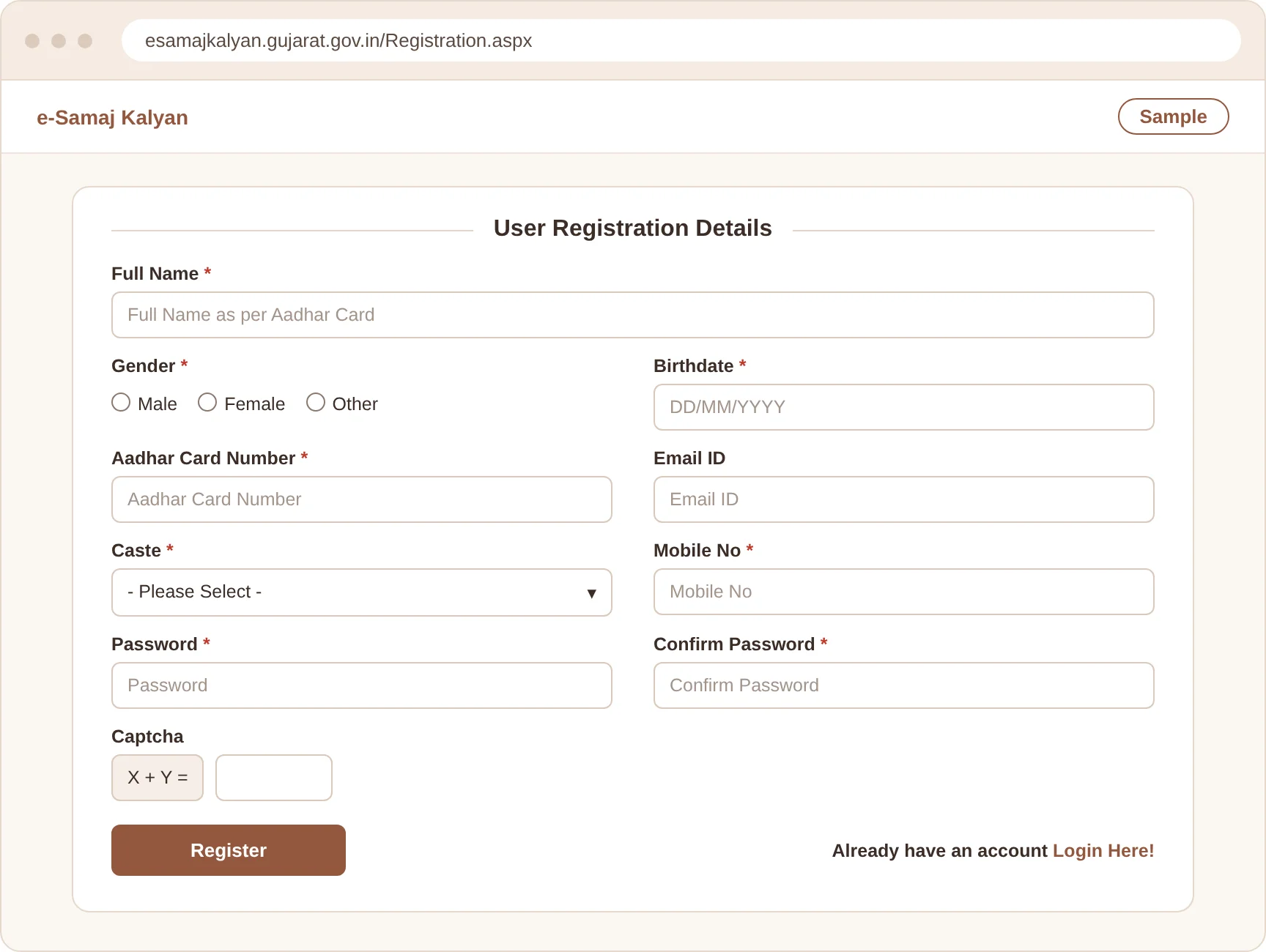
Be careful with the name, date of birth, caste and gender. You can change them only until you fill in your first scheme form. The Aadhaar number can’t be changed at all.
2Fill in the form
After you log in, the home page shows the schemes meant for your caste. Click Dr. Ambedkar Awas Yojana and the form opens in four tabs, each saved with “Save & Next”. To see every question beforehand, open the official application form (PDF, in Gujarati).
Tab 1: Your details
Already filled in from your profile. Check them and correct what’s allowed.
Tab 2: Scheme details
Tab 3: Documents
Upload each document marked with a star, and type in its number where it has one.
Tab 4: Terms
Read the terms and conditions, tick the box and press “Save Application”.
A window then shows your application number. Note it down, and print the application using the print button in the same window.
3After you apply
Your applications are listed under Application List, where you can view or print them again. If the office sends yours back, an edit button (“Sudharo”) appears next to it. Read the note, correct the form and submit it again.
To check the status, use View Application Status on the portal with your application number and date of birth. If you forget your user ID, the portal sends it to your mobile once you enter your Aadhaar number and date of birth.
Common questions about Dr. Ambedkar Awas Yojana
Who can apply for Dr. Ambedkar Awas Yojana in Gujarat?
Scheduled Caste families who are natives of Gujarat, with a yearly income of up to ₹6 lakh, where the applicant is at least 21. The family should own an open plot, live in a kutcha or unsafe house, or be able to build on the first floor of an existing house with the owner’s consent. No one in the family should have had a house under any government housing scheme before.
How much money does the scheme give?
₹1,70,000, paid in four instalments: ₹30,000 with the approval order, ₹80,000 at plinth level, ₹50,000 once the roof is cast and ₹10,000 when the house and toilet are complete.
Is the amount ₹1.20 lakh or ₹1.70 lakh?
₹1.70 lakh. myScheme still shows the older ₹1.20 lakh, paid in three instalments. The department’s own page on e-Samaj Kalyan now gives ₹1,70,000 in four instalments, and that is the figure to follow.
Can I get this if my family already got a PM Awas Yojana house?
No. The scheme’s rules say that neither the applicant nor any family member should have taken help under any government housing scheme, and PM Awas Yojana is one of them. You also sign an affidavit saying so.
Can I apply offline?
The department’s process is online, through the e-Samaj Kalyan portal. For help, the District Deputy Director, Scheduled Caste Welfare handles the scheme in cities and the District Social Welfare Officer in villages.
How long do I get to finish the house?
Two years from the day the first instalment is paid. The last ₹10,000 comes only once the house, with its toilet, is ready.
Awas Score
Is this the right scheme for you? Check every housing scheme your family can get.
Find out your family’s Awas Score in 2 minutes.
Get my Awas Score