PM Awas Yojana Gramin Eligibility Check
In shortOfficial website
- Village families with no house, or living in a kutcha house, can get one.
- You get ₹1.20 lakh to build the house (₹1.30 lakh in hilly areas).
- A government job at home, a member earning over ₹15,000 a month, or owning a car or tractor usually rules you out.
- There is no online form to fill. Names reach the list through a government survey.
₹1.20 lakhto build a house in the plains
₹1.30 lakhin hilly and hard-to-reach areas
90–95 daysof MGNREGA wages for work on your own house
What is PM Awas Yojana Gramin?
Pradhan Mantri Awas Yojana Gramin (PMAY-G) is a central government scheme run by the Ministry of Rural Development. It gives village families money to build a house if they have no home at all, or only a kutcha, run-down one.
The government has extended the scheme to 2028-29. In that time it aims to build 2 crore new houses in villages. So if your turn hasn’t come yet, you still have a chance.
Full details of the scheme, and the beneficiary list, are on the official PMAY-G website.
Who is eligible for PM Awas Yojana Gramin?
The first check is whether you already have a pucca house. Families whose house has pucca walls or a pucca roof, or more than two rooms, are left out at the start. After that, the 10 points below are checked. If even one of them applies, the name is dropped automatically (government notice).
Who can get a house
- Families living in a village
- Families with no house of their own
- Families in a kutcha house with two rooms or fewer
- Families with no pucca house anywhere else
Who usually doesn’t get one
- Someone in the family has a government job
- Any member earns more than ₹15,000 a month
- The family pays income tax
- The family pays professional tax
- The family owns a car, jeep or motorised three-wheeler
- The family owns a tractor or other large farm machine
- The family has a Kisan Credit Card limit of ₹50,000 or more
- The family runs a non-farm business registered with the government
- The family owns 2.5 acres or more of irrigated land
- The family owns 5 acres or more of unirrigated land
Is your family eligible? Find out in three questions
Answer three quick questions. Each answer tells you what it means for your family.
Does your family live in a village?
YesGo to question 2.
NoThis scheme is only for villages. In a town or city, see PM Awas Yojana Urban 2.0.
Is your family homeless, or living in a kutcha house with two rooms or fewer?
YesGo to question 3.
NoA house with pucca walls or a pucca roof, or with more than two rooms, is left out at the start.
Does any of the 10 points under “Who usually doesn’t get one” above apply to your family?
YesEven one is enough for the name to be dropped, such as a government job or someone earning over ₹15,000 a month.
NoGood. Your family meets the basic rules.
Next, check whether your name is on the village list. If it isn’t, you can get it added in the new Awaas+ survey.
Check your name in the PMAY-G list Not on the list? Get added in the Awaas+ survey
Want a clear answer for your family?
These three questions cover only the basic rules. The full check goes further, and every housing scheme, central or state, has rules of its own. Awas Score matches your family’s details against them for you.
- Your Awas ScoreHow well your family fits the rules, as one simple score.
- Schemes that matchWhich central and state housing schemes your family may be eligible for.
- What holds you backWhere your family misses a scheme’s rules, one rule at a time.
Awas Score is an independent service, not a government website. It shows where your family stands. It can’t get you a house or bring your turn sooner.
Who gets a house first?
There are a lot of eligible families, so houses are given out in a set order. Those who need a house most get their turn first (government factsheet).
Always put first
These families go to the top of the list automatically:
- Homeless families
- Families living by begging
- Manual scavengers
- Primitive tribal groups
- Legally freed bonded labourers
Then, by the state of the house
Among families in kutcha houses, the smaller the house, the sooner the turn:
- No room
- 1 room
- 2 rooms
Fewer rooms, earlier turn.
Then, by the hardships the family faces
Each of these that applies to your family moves it up. The more that apply, the sooner your turn:
- Nobody in the family is aged 16 to 59.
- A woman heads the family, and there is no man aged 16 to 59.
- No one in the family over 25 can read and write.
- A family member has a disability, and there is no able-bodied adult.
- The family has no land and lives on daily wages.
Your place in this order is the number next to your name in the village list. Check your number in the PMAY-G list.
No land of your own? Can you still get a house?
Yes. Families who don’t own land to build on are also eligible, as long as they meet the other conditions. The state government gives such families land for the house. It could be government land, panchayat common land, community land, or land belonging to another local body.
Getting the land often takes time, though. According to the government’s reply in the Lok Sabha in August 2026, this is where landless families across the country stand:
Landless families found eligible5.62 lakh
- 3.26 lakhfamilies have been given land or help
- 2.36 lakhfamilies are still waiting for land
States are also under pressure to provide land. According to an earlier Lok Sabha reply, if a state doesn’t give land to its landless families, that many houses can be taken off its target and given to other states.
Each state gives land in its own way. So if you don’t have land, ask your gram panchayat or block office how landless families in your state are being given land, and whether your name is on that list.
In whose name is the house given?
The house is given in the name of the woman of the household, or jointly in the names of husband and wife. Only for a widower, an unmarried or separated person, or a transgender person is the house in their own name.
How much money do you get to build the house?
The amount for building the house depends on where you live:
To build a house in the plains
₹1.20 lakh
In hill states, hard-to-reach areas and some selected districts
₹1.30 lakh
MGNREGA wagesIf you build your own house, you also get wages under MGNREGA.
90 to 95 daysFor a toiletYou can get help to build a toilet under Swachh Bharat Mission.
Up to ₹12,000
The money doesn’t come all at once. It comes in instalments, straight into your bank account, and each new instalment follows as the house goes up.
The house must be at least 25 square metres, with a separate space for cooking.
What the house looks like and who picks the design
No contractor builds the house for you under this scheme. According to the government, PM Awas Yojana Gramin is beneficiary-led: the family gets the house built itself, and the money comes into its account in instalments. These rules apply while building:
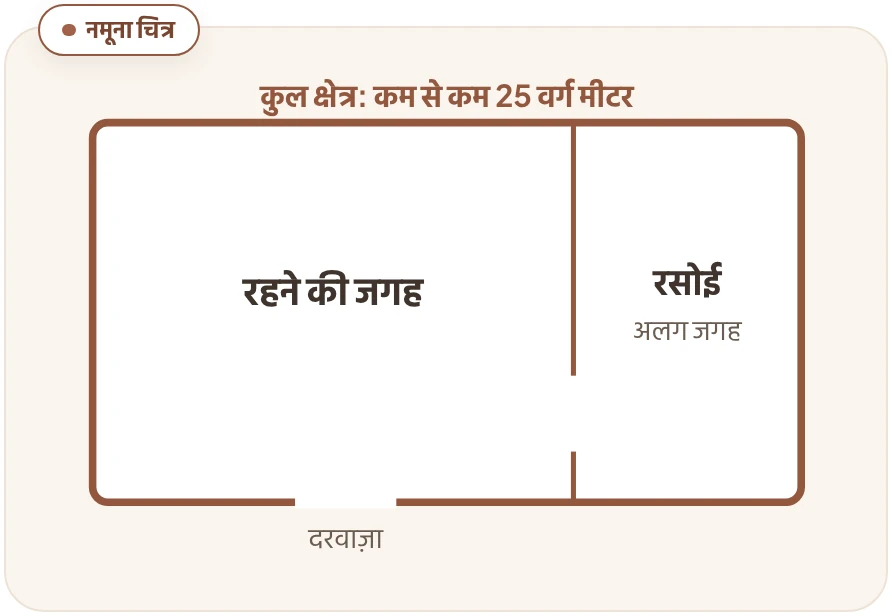
- 25 m²Minimum sizeThe house must be at least 25 square metres.
- KitchenA separate cooking spaceThe house needs its own space for cooking in a clean, hygienic way.
- 12 monthsTime to finishThe house has to be finished within 12 months of the sanction date.
The 12-month rule is in the scheme guidelines. As the work moves forward, the next instalment comes in step with it.
You also get help choosing a design. The Ministry of Rural Development worked with UNDP and IIT Delhi to study village houses across different states, and published region-wise house designs in a book called ‘Pahal’. The designs take into account local weather, terrain and way of life, as well as disasters like floods and earthquakes. Beneficiaries can pick the design that suits them.
The menu on the official PMAY-G website also has a separate section called Housing Typologies. You can ask your block office about designs for your area too.
How do names get on the list?
You can’t apply for this scheme directly by filling in an online form. Names reach the list through a government survey:
- A survey is done. Names were first taken from the SECC 2011 list. Families left out were then added in the Awaas+ survey. A new Awaas+ survey has been running since 2024, and you can even survey yourself on a mobile app.
- The gram sabha checks the list. The list is read out at the village gram sabha to check that the right people are on it.
- The house is sanctioned. Once the name is confirmed, the house is sanctioned and the first instalment reaches your account.
Checking your name in the PMAY-G list takes a few simple steps. If your name was missed, you can get it added by doing a self-survey on your phone or by going to your gram panchayat.
For the survey, keep the Aadhaar number of the person in whose name it’s being done ready, along with correct details of your family, income, land and current house. See the full list of what you need in the Awaas+ survey and application process.
What to do if your name is wrongly removed
Sometimes an eligible family’s name gets removed by mistake during the survey or checks. If that happens to you, don’t stay quiet. There are chances to get your name back:
- Speak up at the gram sabha. The list is finalised at the gram sabha. That’s where eligible names are added and ineligible ones removed. Raise your case at that meeting and explain why you are eligible.
- File a written objection. After the gram sabha, the lists of approved and rejected families are put up for everyone to see, and objections are taken for a few days. Submit your written objection to the block office or the district rural development office during this time.
- The appellate committee decides. The district appellate committee gives the list its final approval. It looks at the objections before confirming the list.
Always get a receipt when you file an objection. The dates for objections differ from district to district, so keep checking with your gram panchayat or block office.
Common questions about eligibility
I own a motorbike. Can I still get a house?
Yes. Since 2024, owning a two-wheeler no longer gets your name removed. If you meet the other conditions, your turn can come.
How much land gets your name removed?
If the family owns 2.5 acres or more of irrigated land, or 5 acres or more of unirrigated land, the name is removed.
Does the ₹15,000 limit apply to the whole family’s income?
No. The limit is on the monthly income of any one family member. If any single member earns more than ₹15,000 a month, the name is removed.
Can a family living in a city get this house?
No. PM Awas Yojana Gramin is only for village families. There is a separate scheme, PM Awas Yojana Urban, for families in towns and cities.
Can I choose my own house design under PM Awas Yojana Gramin?
Yes. The government offers several designs suited to each region, and you can choose the one that suits you. The house just needs to be at least 25 square metres, with a separate space for cooking.
Can I get a PM Awas Yojana Gramin house if I don’t own land?
Yes, if your family meets the other conditions. The state government gives such families land to build on, such as government or panchayat land. Ask your gram panchayat or block office how it works in your state.
Awas Score
Will your turn come or not?
Find out your family’s Awas Score in 2 minutes.
Get my Awas Score